Case framing at a high level
The original candidate list had the familiar shape of a rare-disease analysis: a small number of genes with strong prior evidence, a longer tail of plausible candidates, and several entries whose rank could not be explained without reconstructing the pipeline. The practical question was not how to generate another score. It was how to identify the candidates for which the genomic, phenotypic, and cellular arguments genuinely agreed.
We defined the decision in advance: select a bounded set of research priorities and specify the cardiac experiment that would most efficiently challenge each one. Clinical classification was explicitly outside scope. That boundary allowed us to treat uncertainty as an analytical object rather than pressure the evidence into a diagnostic category.
Reconstructing the evidence graph
Variant records were normalized to a consistent genome build and transcript set. Consequence disagreements, low-confidence predicted loss-of-function annotations, splice predictions, population frequencies, and domain positions were retained as separate evidence nodes. Gene-level constraint was connected to, but not merged with, variant-level rarity. Disease validity, inheritance, and phenotype annotations were versioned independently.
The graph prevented double counting. A curated disease association and a phenotype similarity score can derive from the same underlying literature; treating them as independent confirmation inflates confidence. We tagged shared provenance and grouped evidence by family so repeated representations of one fact could not masquerade as convergence.
- Variant consequence and transcript relevance.
- Population frequency and constraint with uncertainty.
- Inheritance, segregation availability, and allelic mechanism.
- Phenotype fit across cardiac and extracardiac branches.
- Cardiomyocyte state and pathway localization.
- Independent-reference transfer and competing explanations.
Phenotype and mechanism stratification
The phenotype representation was divided into structural myocardial disease, rhythm and conduction features, functional impairment, developmental or congenital findings, skeletal-muscle involvement, and metabolic or multisystem features. Broad cardiac ancestors were used for recall, while specific observations controlled discrimination. Term influence was inspected so one general label could not determine the ranking.
Candidates were then stratified by proposed allelic mechanism. A dominant altered-protein hypothesis, a haploinsufficiency hypothesis, a recessive loss-of-function model, and a mitochondrial or metabolic mechanism require different priors and different experiments. This step materially changed the interpretation because the same gene-level evidence can support one mechanism while contradicting another.
Cardiac cell-state integration
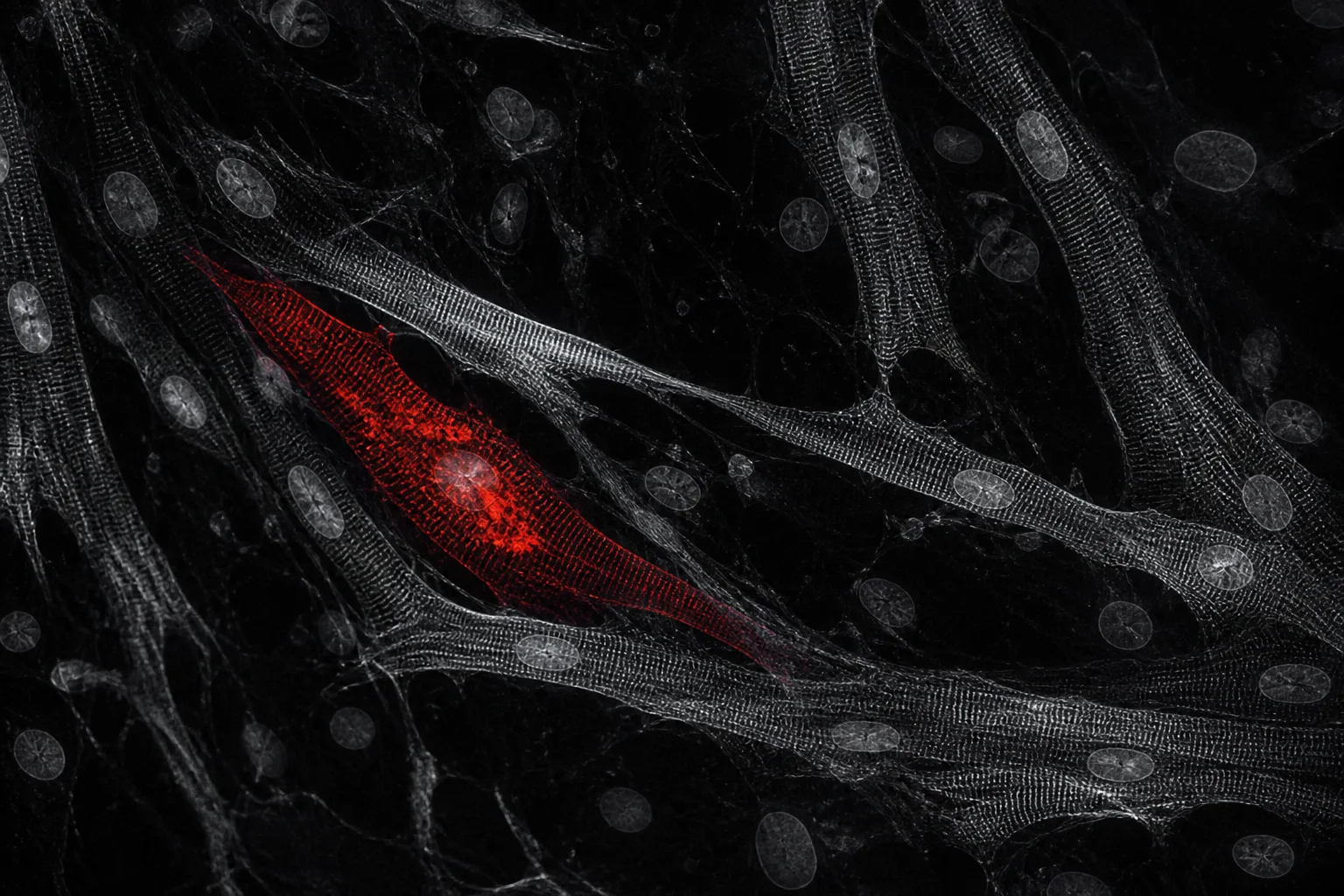
Cardiac single-cell references were analyzed with donor-aware summaries and hierarchical cell labels. We tested whether candidate evidence localized beyond broad heart expression to ventricular or atrial cardiomyocyte programs, conduction-associated neighborhoods, fibroblast remodeling, vascular compartments, or immune states. Expression-matched controls addressed the tendency of abundant cardiac genes to dominate.
State localization was interpreted as an experimental-context prior. It did not convert a candidate into a disease gene. A candidate supported by a contractile phenotype and ventricular sarcomere program suggested a cardiomyocyte mechanics assay; a candidate supported by a multisystem metabolic phenotype and broad energetic program suggested a different model and readout.
Stress tests and decision rule
We recomputed priorities after removing constraint, phenotype, prior disease knowledge, and cell-state evidence one layer at a time. We varied evidence weights, ontology depth, transcript choice, and atlas inclusion. Candidate-specific rank trajectories showed whether a priority was supported broadly or sat at the top only under one convenient configuration.
The final research queue required support from at least two independent evidence families, mechanism compatibility, and a named disconfirming observation. Candidates that were biologically interesting but fragile were not discarded; they were moved to a clarification queue with the exact missing evidence identified.
What the analysis changed
The stable core was enriched for genes whose known or proposed biology aligned with sarcomere organization, cardiomyocyte mechanics, and the represented cardiac phenotype. Some less-characterized candidates remained credible because their cellular and phenotypic evidence converged independently of constraint. Others fell when a broad cardiomyopathy term, a single annotation database, or general cardiac abundance was removed.
The most important change was not the ordering of the list. It was the conversion of each retained candidate into a testable statement: proposed molecular direction, relevant cardiac state, measurable cellular consequence, and result that would weaken the hypothesis.
What the analysis establishes
A stable sarcomere-centered core emerged
Candidates with compatible allelic mechanism, phenotype, and ventricular contractile context remained prioritized across model perturbations.
Several high ranks were prior dependent
Some candidates moved sharply when gene constraint or one disease annotation source was removed.
Cell context changed the experiment
The same gene rank implied different follow-up depending on whether support localized to cardiomyocyte mechanics, remodeling, conduction, or multisystem metabolism.
Uncertainty became actionable
Fragile candidates were assigned specific clarification needs instead of being labeled generically uncertain.
What we conclude
We conclude that a reproducible evidence stack is more valuable than a definitive-looking composite score. For inherited cardiomyopathy, the strongest research priorities are the candidates whose variant mechanism, phenotype branch, and cardiomyocyte program remain coherent after removal of any one evidence source.
The immediate experimental priorities are mechanism matched: isogenic editing and rescue for variant-specific altered-protein hypotheses; dosage titration for credible haploinsufficiency; engineered cardiac tissue or force measurements for sarcomere-centered mechanisms; and orthogonal metabolic assays for multisystem energetic hypotheses. A candidate should leave the research queue only when the proposed direction and context survive direct perturbation.
Limitations
- The demonstration uses public evidence patterns rather than a prospectively enrolled clinical cohort.
- Segregation, phase, penetrance, and individual-level phenotyping are not recoverable from aggregate public resources.
- Single-cell expression provides context but does not measure variant-specific protein function.
- Well-studied genes have denser evidence graphs, requiring explicit correction for annotation advantage.